Rare Medical News
Advertisement
Spotlight On
Duane Syndrome
Duane Syndrome is a rare disorder described in the medical literature with low prevalence and variable expression.
Prevalence
10 / 10 000
10–20
US Estimated
10–20
Europe Estimated
Age of Onset
Congenital - Childhood

ICD-10
H50.81
Inheritance Pattern
Autosomal dominant
in some cases

Autosomal recessive

Mitochondrial/Multigenic
X-linked dominant
X-linked recessive
Rare View
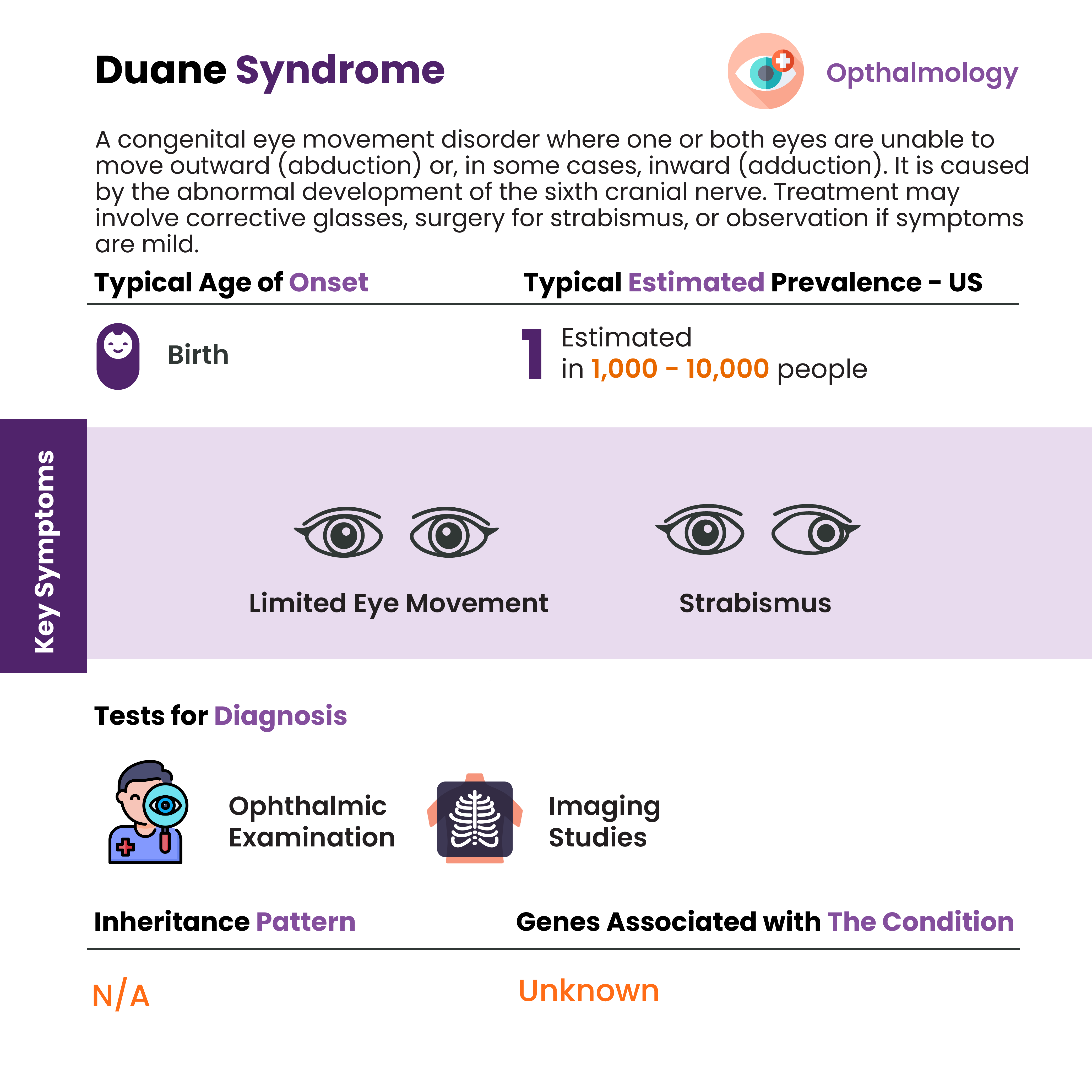
Duane Syndrome is a rare congenital eye condition that affects the movement of one or both eyes. It is caused by abnormal development or miswiring of the nerves controlling the eye muscles, particularly the sixth cranial nerve.
5 Facts you should know
FACT
Duane Syndrome is a congenital eye movement disorder characterized by limited or absent horizontal eye movement and abnormal retraction or widening of the eye fissure upon attempted inward gaze
FACT
It results from aberrant development of the abducens (VI) and oculomotor (III) cranial nerves during early embryogenesis, leading to inadequate innervation of the lateral rectus muscle and inappropriate connections with the medial rectus muscle
FACT
There are three subtypes: Type 1, characterized by limited abduction; Type 2, featuring limited adduction; and Type 3, displaying limited abduction and adduction, with varying severity
FACT
Duane Syndrome may occur unilaterally or bilaterally, often associated with abnormal head posture or compensatory head movements to improve vision
FACT
Diagnosis involves clinical examination, assessing ocular motility, cranial nerve function, and associated anomalies, often requiring periodic ophthalmologic evaluation during childhood
Interest over time
Google searches
Common signs & symptoms
Limitation of horizontal ductions
Globe retraction and narrowing of palpebral fissure on adduction
Upshoots/downshoots on attempted adduction due to co-contraction and slippage
Strabismus in primary position and abnormal head posture to maintain binocular single vision
Some patients develop amblyopia, anisometropia, or diplopia
Current treatments
Non-surgical management
- Correct refractive error; amblyopia therapy when present. 
- Prisms may help in selected patients with small deviations and head posture. 
Surgery (indications and goals)
- Primary indications: significant deviation in primary gaze and/or functionally important abnormal head posture. 
- Additional goals: reduce cosmetically significant retraction and severe upshoot/downshoot. 
- Surgery is tailored (muscle recession/transposition strategies) and aims to improve alignment and posture—not normalize innervation.
References:
Gutowski NJ, Chilton JK. The congenital cranial dysinnervation disorders. <i>Arch Dis Child.</i> 2015;100(7):678–681. doi:10.1136/archdischild-2014-307678 Huber A. Electrophysiology of the retraction syndromes. <i>Br J Ophthalmol.</i> 1974;58(3):293–300. doi:10.1136/bjo.58.3.293 Engle EC. The genetic basis of congenital strabismus. <i>Arch Ophthalmol.</i> 2007;125(2):189–195. doi:10.1001/archopht.125.2.189 Yamada K, Andrews C, Chan WM, et al. Heterozygous mutations of the CHN1 gene in Duane retraction syndrome. <i>Nat Genet.</i> 2003;35(4):318–321. doi:10.1038/ng1261