Rare Medical News
Advertisement
Spotlight On
Spinal muscular atrophy (SMA)
Spinal muscular atrophy (SMA) is a rare neuromuscular disorder that results in the loss of motor neurons and progressive muscle wasting
Prevalence
10/100,000
33,100
US Estimated
51,350
Europe Estimated
Age of Onset

ICD-10
G12.9
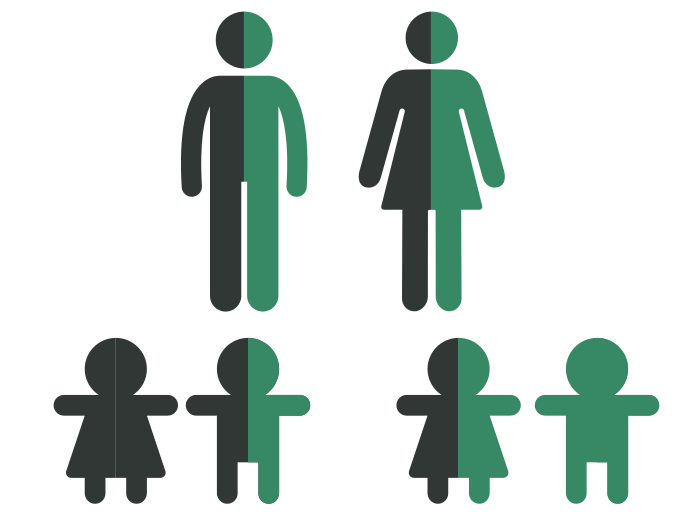
Inheritance
Autosomal dominant
Autosomal recessive
Mitochondrial/Multigenic
X-linked dominant
X-linked recessive
5 Facts you should know
FACT
The term spinal muscular atrophy (SMA) refers to a group of genetic disorders all characterized by degeneration of anterior horn cells and resultant muscle atrophy and weakness
FACT
The severity of SMA is highly variable and the clinical features can be classified into 4 main phenotypes on the basis of age of onset and maximum motor function achieved
FACT
The clinical severity of SMA correlates inversely with SMN2 gene copy number and varies from extreme weakness and paraplegia of infancy to a mild proximal weakness of adulthood
FACT
The incidence of SMA in the United States is 1:10,000/11,000 live births
FACT
SMA affects individuals of all ethnic groups
Interest over time
Google searches
Common signs & symptoms
Muscle Weakness
Hypotonia (Low Muscle Tone)
Poor Motor Development
Difficulty Breathing and Swallowing
Muscle Atrophy
Joint Contractures
Current treatments
Treatment for SMA may vary depending on the subtype of SMA and severity of symptoms, but generally focuses on supportive care to increase the person's quality of life. In general, treatment may include physical therapy and assistive equipment to increase mobility, such as leg braces, walkers, and wheelchairs. Back braces may be used to assist sitting and prevent scoliosis and other complications affecting the backbone. Special breathing exercises, cough machines, and chest physiotherapy can help maintain the function of the lungs and keep the airways clear of mucous, especially in times of illness. A dietitian may help support nutrition if eating or swallowing becomes difficult.
For SMA types 1, 2, 3, and 4, nusinersen (Spinraza) is the first and only FDA approved treatment. Continued treatment with nusinersen has been found to increase motor function and slow the progression of symptoms. Many babies and young children with types 1 and 2 are able to reach developmental milestones and maintain those milestones over time. In general, breathing problems, nutrition problems, and hospital admissions also decrease. Older children with type 3 and adults with type 4 have also been shown to benefit from continuous treatment with nusinersen, including, for some, regaining the ability to walk longer distances, improving arm movement, and slowing or stopping the progression of the disorder. Ongoing, long term medical studies continue to report improvements. However, response to treatment does vary and some people with SMA types 1, 2, 3, or 4 may not respond to the drug at all or may have medical complications that prevent use of the treatment.
Top Clinical Trials
| Title | Description | Phases | Status | Interventions | More Information |
|---|---|---|---|---|---|
| Efficacy and Safety of Intrathecal OAV101 (AVXS-101) in Pediatric Patients With Type 2 Spinal Muscular Atrophy (SMA) | To evaluate the efficacy, safety and tolerability of intrathecal (IT) OAV101 in treatment naive patients with Type 2 spinal muscular atrophy (SMA) who are ≥ 2 to < 18 years of age over a 15 month trial duration. | Phase 3 | Recruiting | Genetic: OAV101|Procedure: Sham control | More information |
| A Study to Evaluate Higher Dose (HD) Nusinersen (BIIB058) in Participants With Spinal Muscular Atrophy Previously Treated With Risdiplam | The primary objective of this study is to evaluate motor function following treatment with HD nusinersen in participants with spinal muscular atrophy (SMA) previously treated with risdiplam. The secondary objective of this study is to evaluate the safety and tolerability of HD nusinersen in participants with SMA previously treated with risdiplam. | Phase 3 | Recruiting | Drug: Nusinersen | More information |
| A Study to Investigate the Safety and Efficacy of RO7204239 in Combination With Risdiplam (RO7034067) in Ambulatory Children With Spinal Muscular Atrophy | RO7204239 in combination with risdiplam, which is designed to increase the amount of SMN protein throughout the body, has the potential to further improve motor function and clinical outcomes for people living with SMA. This trial will study the safety and efficacy of RO7204239 in combination with risdiplam in children aged 2-10 years with spinal muscular atrophy (SMA) that are ambulant. | Phase 2|Phase 3 | Not yet recruiting | Drug: RO7204239|Drug: Placebo|Drug: Risdiplam | More information |
| Safety and Efficacy of Intravenous OAV101 (AVXS-101) in Pediatric Patients With Spinal Muscular Atrophy (SMA) | To evaluate the safety, tolerability and efficacy of intravenous administration of OAV101 (AVXS-101) in patients with spinal muscular atrophy (SMA) with bi-allelic mutations in the survival motor neuron 1 (SMN1) gene weighing ≥ 8.5 kg and ≤ 21 kg, over a 12 month period. | Phase 3 | Recruiting | Genetic: OAV101 | More information |
| Study of Nusinersen (BIIB058) in Participants With Spinal Muscular Atrophy | The primary objectives of this study are to examine the clinical efficacy of nusinersen administered intrathecally at higher doses to participants with spinal muscular atrophy (SMA), as measured by change in Children's Hospital of Philadelphia Infant Test of Neuromuscular Disorders (CHOP INTEND) total score (Part B); to examine the safety and tolerability of nusinersen administered intrathecally at higher doses to participants with SMA (Parts A and C). | Phase 2|Phase 3 | Recruiting | Drug: Nusinersen | More information |
| A Study of Risdiplam in Infants With Genetically Diagnosed and Presymptomatic Spinal Muscular Atrophy | A global study of oral risdiplam in pre-symptomatic participants with spinal muscular atrophy (SMA). | Phase 2 | Recruiting | Drug: Risdiplam | More information |
Top Treatments in Research
| Agent | Class/Mechanism of Action | Development Status | Company | Clinical Studies | More Information |
|---|---|---|---|---|---|
| OAV101 (intrathecal administration) | Zolgensma is an adeno-associated virus (AAV) 9 based gene therapy designed to deliver a copy of the SMN1 gene to encode for human SMN protein. It is a recombinant form of self-complementary AAV9, which contains human SMN protein-encoding transgene. | Phase 3 | Novartis Pharmaceuticals|Novartis | More information | More information |
| RO7204239 (GYM329) | GYM329 is an investigational anti-myostatin antibody that is designed to target skeletal muscles, potentially increasing their size and growth[ii]. Myostatin plays an important role in the regulation of skeletal muscle size by controlling growth. Inhibiting myostatin may help muscles grow in size and strength. GYM329 in combination with risdiplam, which is designed to increase the amount of SMN protein throughout the body, has the potential to further improve motor function and outcomes for people living with SMA2. | Phase 2|Phase 3 | Hoffmann-La Roche | More information | More information |