Rare Medical News
Advertisement
Spotlight On
Resistance to Thyroid Hormone Syndrome
Resistance to Thyroid Hormone (RTH) syndrome is a rare, inherited disorder where the body's tissues are less sensitive to thyroid hormones, resulting in elevated levels of thyroid hormone in the blood but normal or high Thyroid Stimulating Hormone (TSH) levels
Prevalence
<1 / 40 000
1,000–2,000
US Estimated
1,500–3,000
Europe Estimated
Age of Onset
Childhood

ICD-10
E07.9
Inheritance Pattern
Autosomal dominant

Autosomal recessive
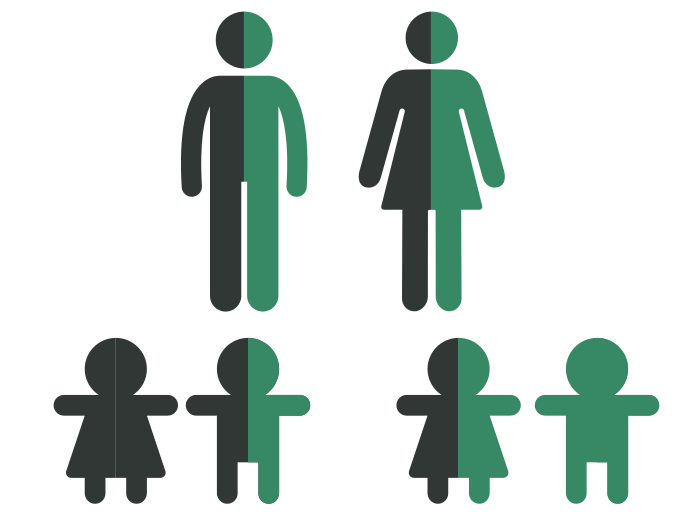
Mitochondrial/Multigenic
X-linked dominant
X-linked recessive
5 Facts you should know
FACT
Resistance to thyroid hormone (RTH) is a rare inherited endocrine disorder, most often caused by dominant mutations in the thyroid hormone receptor beta (THRB) gene, impairing tissue responsiveness to circulating thyroid hormones
FACT
Biochemically, RTH is characterized by elevated serum free T4 and T3 with inappropriately normal or elevated TSH, distinguishing it from primary hyperthyroidism
FACT
Clinical presentation is highly variable — some patients are asymptomatic, while others show goiter, tachycardia, hyperactivity, learning difficulties, or features of hypothyroidism, reflecting tissue-specific resistance
FACT
Differential diagnosis includes TSH-secreting pituitary adenoma, making genetic testing critical for confirmation
FACT
Management is individualized and may involve beta-blockers for tachycardia, thyroid ablation in select cases, or watchful monitoring, depending on symptom severity and target organ involvement
Interest over time
Google searches
Common signs & symptoms
Variable presentation
some patients are asymptomatic
Goiter
Symptoms of thyroid hormone excess and/or hypothyroidism-like features
Behavioral/attention problems in children
Hearing loss in some cases
Family history of thyroid hormone abnormalities
Current treatments
Many patients require no treatment, only monitoring
Symptomatic management depending on presentation
Beta-blockers for tachycardia, palpitations
Thyroid hormone analogs (like TRIAC) in selected cases to normalize feedback loops
Levothyroxine may be used in cases with tissue-specific hypothyroidism
Multidisciplinary follow-up
endocrinology, cardiology, developmental pediatrics if needed