Rare Medical News

Advertisement

Spotlight On

Chiari Malformations

Chiari malformations are a group of complex brain abnormalities that affect the area in lower posterior skull where the brain and spinal cord connect

Prevalence

~50–100 / 100,000

US Estimated

~10–50 / 100,000

Europe Estimated

Age of Onset

Childhood - Adolescence
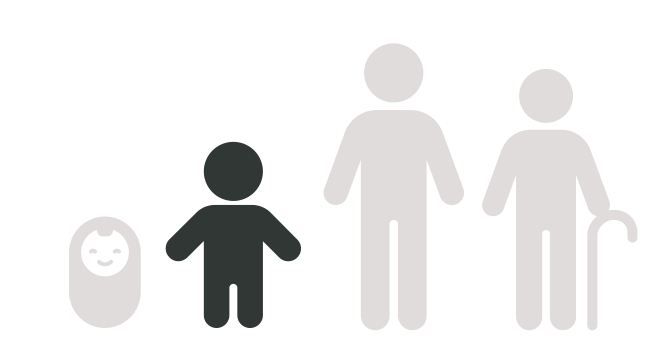
ageofonset childhood https://raremedicalnews.com/wp-content/uploads/2026/01/Depositphotos_189386098_L.jpg

ICD-10

Q07.0

Inheritance Pattern

Autosomal dominant

no https://raremedicalnews.com/wp-content/uploads/2026/01/Depositphotos_189386098_L.jpg

Autosomal recessive

no https://raremedicalnews.com/wp-content/uploads/2026/01/Depositphotos_189386098_L.jpg

Mitochondrial/Multigenic

no https://raremedicalnews.com/wp-content/uploads/2026/01/Depositphotos_189386098_L.jpg

X-linked dominant

no https://raremedicalnews.com/wp-content/uploads/2026/01/Depositphotos_189386098_L.jpg

X-linked recessive

no https://raremedicalnews.com/wp-content/uploads/2026/01/Depositphotos_189386098_L.jpg

5 Facts you should know

FACT

1

Arnold–Chiari malformation is a malformation of the skull

FACT

2

It is usually caused by structural defects in the brain and spinal cord that occur during fetal development

FACT

3

It consists of a downward displacement of the cerebellar tonsils through the foramen magnum

FACT

4

The cerebrospinal fluid outflow is caused by phase difference in outflow and influx of blood in the vasculature of the brain

FACT

5

Headache is the hallmark sign of Chiari malformation, especially after sudden coughing, sneezing, or straining

Chiari Malformation is also known as...

Chiari Malformation is also known as:

  • CM

  • Arnold- Chiari malformation

What’s your Rare IQ?

What part of the body is the site of the Chiari malformation?


Common signs & symptoms

Occipital or suboccipital headaches, classically worsened by Valsalva maneuvers (coughing, sneezing, straining)

Neck pain and cervical stiffness

Dizziness, vertigo, or balance disturbances

Sensory abnormalities, including numbness or paresthesias in the upper extremities

Weakness or coordination difficulties

Cranial nerve–related symptoms, such as dysphagia, dysarthria, or hoarseness

Sleep-disordered breathing, including central sleep apnea (in some patients)

Symptoms related to syringomyelia, when present (e.g., cape-like sensory loss, motor deficits)

Current treatments

Observation and clinical monitoring for asymptomatic or mildly symptomatic patients

Symptomatic management, including analgesics and physical therapy when appropriate

Posterior fossa decompression surgery (with or without duraplasty) for patients with significant symptoms, cerebrospinal fluid flow obstruction, or progressive neurological deficits

Management of associated conditions, such as syringomyelia or hydrocephalus, when present