Rare Medical News
Advertisement
Spotlight On
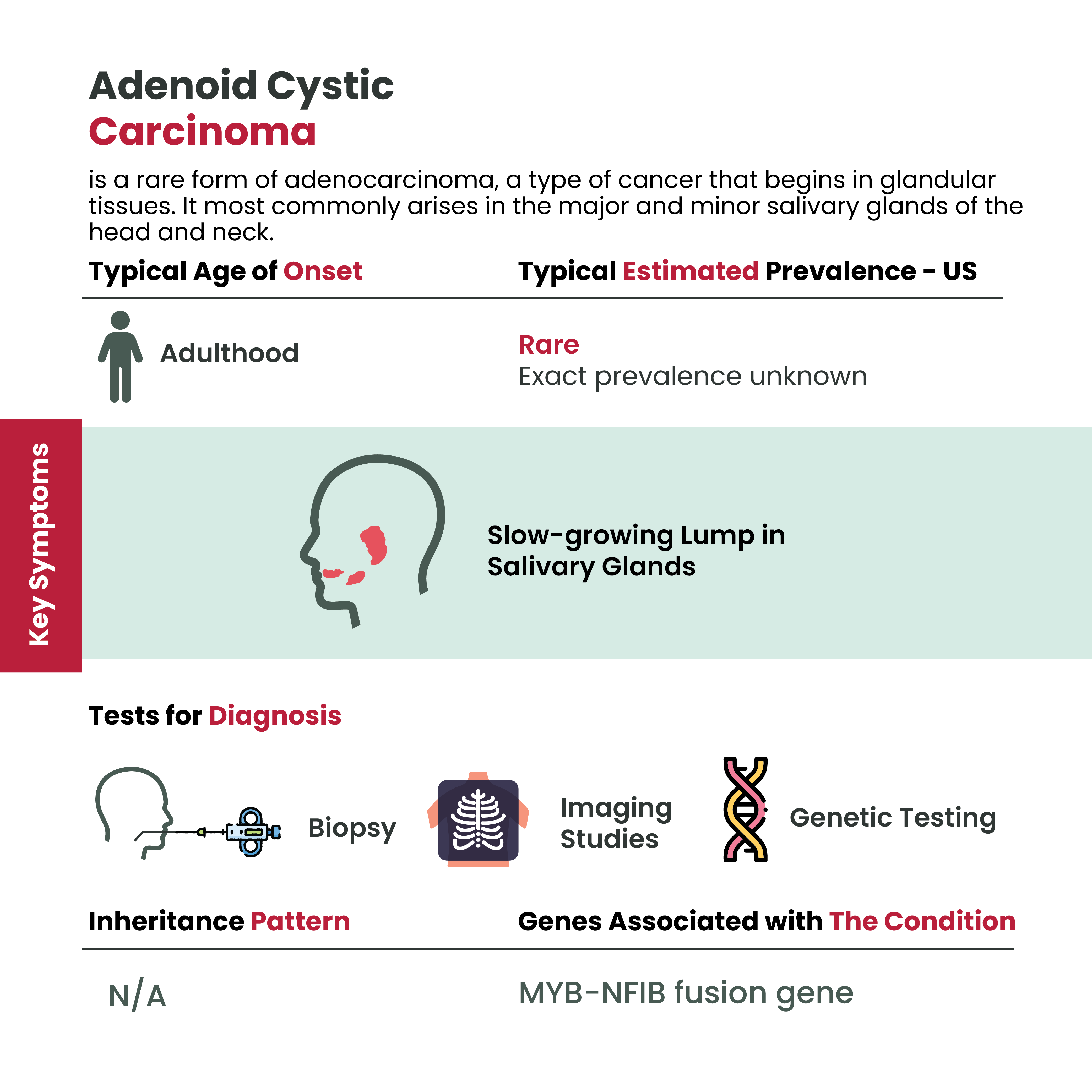
Adenoid cystic carcinoma
A relatively rare tumor of the minor and major salivary glands
Prevalence
Unknown
US Estimated
Unknown
Europe Estimated
Age of Onset

ICD-10
C06.9
Inheritance
This condition does not appear to have a clear pattern of inheritance.
Rare View
A rare type of cancer that arises from the secretory glands, often in the salivary glands, characterized by slow growth but a high tendency for perineural invasion and recurrence. Treatment typically involves surgery and radiotherapy.
5 Facts you should know
FACT
It is uncommon in the parotid gland while it is much more frequent in the submandibular gland and in minor salivary and mucinous glands
FACT
ACC has been traditionally subdivided into three histological groups - cribriform, tubular, and solid
FACT
Local recurrence occurs in approximately 50% of patients
FACT
Patients may survive for years with metastases because this tumor is generally well-differentiated and slow growing
FACT
Activation of the oncogenic transcription factor gene MYB is the key genomic event of ACC and seen in the vast majority of cases
Interest over time
Google searches
Common signs & symptoms
Swelling or lump
A noticeable lump or swelling in the affected area, typically in the salivary glands, head and neck region, or other sites where ACC may occur
Difficulty swallowing
Tumors in the throat or esophagus may lead to difficulty swallowing or a sensation of something stuck in the throat
Changes in voice
Tumors near the vocal cords or larynx may cause changes in voice quality, such as hoarseness or a raspy voice
Facial weakness or numbness
Tumors near facial nerves may cause facial weakness, paralysis, or numbness on one side of the face
Current treatments
The treatment of adenoid cystic carcinoma (ACC) typically involves a multidisciplinary approach and may include one or more of the following modalities:
Surgery
Surgical resection is often the primary treatment for localized ACC. The goal is to remove the tumor along with a margin of healthy tissue to reduce the risk of recurrence. Depending on the location and extent of the tumor, surgery may involve removing part or all of the affected organ (e.g., salivary gland, trachea)
Radiation therapy
Radiation therapy may be used before or after surgery to target any remaining cancer cells or to shrink tumors that cannot be surgically removed. It may also be used as a primary treatment for inoperable tumors or to relieve symptoms in advanced cases
Chemotherapy
Chemotherapy is not typically considered effective as a primary treatment for ACC. However, it may be used in combination with radiation therapy for certain cases, such as advanced or metastatic disease, to help control tumor growth and improve symptoms
Targeted therapy
Targeted therapies, such as molecularly targeted drugs or immunotherapy, are being investigated for the treatment of ACC. These treatments target specific molecular pathways involved in cancer growth and may offer new options for patients with advanced or recurrent disease
Top Clinical Trials
| Title | Description | Phases | Status | Interventions | More Information |
|---|---|---|---|---|---|
| A Multi-omics Approach to Disclose Progression and Underlying Biology of Head and Neck Adenoid Cystic Carcinoma | The goal of this observational study is to better understand why some people with metastatic adenoid cystic carcinoma (ACC) of the head and neck have slow-growing disease while others have faster-growing or more aggressive disease. Researchers want to learn how the biology of the tumor relates to ea... | Recruiting | Other: Standard of Care (Investigator Choice) | More Info | |
| Tyrosine Kinase Inhibitors in Metastastic Adenoid Cystic Carcinoma | There is no clinical study on epidermal growth factor receptor tyrosine kinase inhibitors has been systematically conducted in adenoid cystic carcinoma. This is a phase II study EGFR TKIs in adenoid cystic carcinoma to evaluate its efficacy in this disease. | Phase 2 | Recruiting | Drug: EGFR-TK Inhibitor | More Info |
| A Phase 2 Trial of Ivonescimab for Patients With Advanced, Metastatic Salivary Gland Cancers | The goal of this study is to evaluate the efficacy and safety of Ivonescimab in participants with advanced, metastatic salivary gland cancers. The name of the study drug involved in this study is: -Ivonescimab (a type of antibody) | Phase 2 | Recruiting | Drug: Ivonescimab | More Info |
| Safety, PK and Efficacy of ONC-392 in Monotherapy and in Combination of Anti-PD-1 in Advanced Solid Tumors and NSCLC | This is a First-in-Human Phase IA/IB/II open label dose escalation study of intravenous (IV) administration of ONC-392, a humanized anti-CTLA4 IgG1 monoclonal antibody, as single agent and in combination with pembrolizumab in participants with advanced or metastatic solid tumors and non-small cell l... | Phase 1, Phase 2 | Active | Drug: ONC-392 Drug: Pembrolizumab Drug: Docetaxel | More Info |
| A Study of Enfortumab Vedotin in People With Adenoid Cystic Carcinoma | The purpose of this study is to find out whether enfortumab vedotin is an effective and safe treatment for people with adenoid cystic carcinoma (ACC). | Phase 2 | Recruiting | Drug: Enfortumab Vedotin | More Info |
| Clinical Trial of HG146 Administered to Participants with Adenoid Cystic Carcinoma | This is a Phase II, open-label, non-randomized, multicenter study to evaluate the clinical efficacy and safety of HG146 in participants with recurrent or metastatic adenoid cystic carcinoma. This study is divided into two stages. 40 participants will be enrolled in the first stage. The efficacy and... | Phase 2 | Recruiting | Drug: HG146 | More Info |
| A Study of XMT-1660 in Participants With Solid Tumors | A Study of XMT-1660 in Solid Tumors | Phase 1 | Recruiting | Drug: XMT-1660 | More Info |
| Epirubicin Interventional Chemotherapy for Sinonasal Adenoid Cystic Carcinoma (SNACC): A Prospective Study | This study is for patients with locally advanced sinonasal adenoid cystic carcinoma (SNACC), a rare and challenging cancer that tends to invade nerves and the skull base. The research aims to test a new precise treatment strategy. First, all participants will receive three sessions of "interventiona... | Phase 2 | Recruiting | Drug: Epirubicin (E) | More Info |
| AL101 Before Surgery for the Treatment of Notch Activated Adenoid Cystic Cancer | This phase Ib trial studies the side effects and possible benefits of AL101 before surgery in treating patients with notch activated adenoid cystic cancer. AL101 may stop the growth of tumor cells by blocking some of the enzymes needed for cell growth. Giving AL101 before surgery may help to control... | Phase 1 | Active | Drug: AL101 Procedure: Therapeutic Conventional Surgery | More Info |
| Nivolumab and Ipilimumab in Treating Patients With Rare Tumors | This phase II trial studies nivolumab and ipilimumab in treating patients with rare tumors. Immunotherapy with monoclonal antibodies, such as nivolumab and ipilimumab, may help the body's immune system attack the cancer, and may interfere with the ability of tumor cells to grow and spread. This tri... | Phase 2 | Active | Procedure: Biospecimen Collection Procedure: Computed Tomography Procedure: Echocardiography Test Biological: Ipilimumab Procedure: Magnetic Resonance Imaging Biological: Nivolumab | More Info |