Rare Medical News
Advertisement
Disease Profile
Aicardi-Goutieres syndrome
Prevalence estimates on Rare Medical Network websites are calculated based on data available from numerous sources, including US and European government statistics, the NIH, Orphanet, and published epidemiologic studies. Rare disease population data is recognized to be highly variable, and based on a wide variety of source data and methodologies, so the prevalence data on this site should be assumed to be estimated and cannot be considered to be absolutely correct.
Unknown
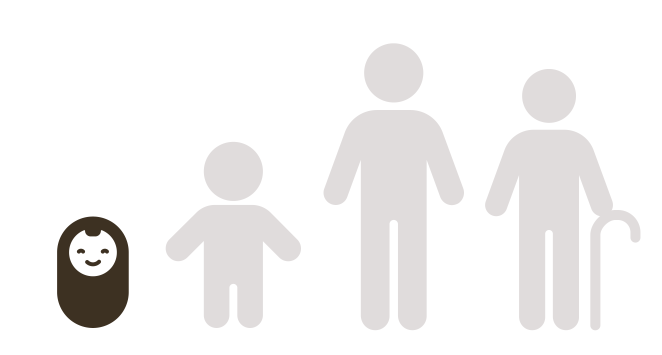
Age of onset
Infancy
ICD-10
G31.8
Inheritance
Autosomal dominant A pathogenic variant in only one gene copy in each cell is sufficient to cause an autosomal dominant disease.

Autosomal recessive Pathogenic variants in both copies of each gene of the chromosome are needed to cause an autosomal recessive disease and observe the mutant phenotype.

X-linked
dominant X-linked dominant inheritance, sometimes referred to as X-linked dominance, is a mode of genetic inheritance by which a dominant gene is carried on the X chromosome.
dominant X-linked dominant inheritance, sometimes referred to as X-linked dominance, is a mode of genetic inheritance by which a dominant gene is carried on the X chromosome.

X-linked
recessive Pathogenic variants in both copies of a gene on the X chromosome cause an X-linked recessive disorder.
recessive Pathogenic variants in both copies of a gene on the X chromosome cause an X-linked recessive disorder.
Mitochondrial or multigenic Mitochondrial genetic disorders can be caused by changes (mutations) in either the mitochondrial DNA or nuclear DNA that lead to dysfunction of the mitochondria and inadequate production of energy.
Multigenic or multifactor Inheritance involving many factors, of which at least one is genetic but none is of overwhelming importance, as in the causation of a disease by multiple genetic and environmental factors.
Not applicable
Other names (AKA)
AGS; Aicardi Goutieres syndrome; Encephalopathy, familial infantile, with calcification of basal ganglia and chronic cerebrospinal fluid lymphocytosis;
Categories
Congenital and Genetic Diseases; Eye diseases; Immune System Diseases;
Summary
Aicardi-Goutieres
There are several types of Aicardi-Goutieres syndrome, depending on the
Symptoms
This table lists symptoms that people with this disease may have. For most diseases, symptoms will vary from person to person. People with the same disease may not have all the symptoms listed. This information comes from a database called theHuman Phenotype Ontology (HPO). The HPO collects information on symptoms that have been described in medical resources. The HPO is updated regularly. Use the HPO ID to access more in-depth information about a symptom.
| Medical Terms | Other Names |
Learn More:
HPO ID
|
|---|---|---|
| 80%-99% of people have these symptoms | ||
| Arrhinencephaly | 0002139 | |
| 80%-99% of people have these symptoms | ||
| Arrhinencephaly | 0002139 | |
| Global developmental delay | 0001263 | |
| Intellectual disability, profound |
IQ less than 20
|
0002187 |
| Multifocal cerebral white matter abnormalities | 0007052 | |
| Porencephalic cyst |
Cavity within brain
|
0002132 |
| 30%-79% of people have these symptoms | ||
| Autoimmunity |
Autoimmune disease
Autoimmune disorder
[more] |
0002960 |
| Brain atrophy |
Brain degeneration
Brain wasting
[more] |
0012444 |
| Cerebral calcification |
Abnormal deposits of calcium in the brain
|
0002514 |
| Chilblains | 0009710 | |
| Chronic CSF lymphocytosis | 0009704 | |
| Developmental regression |
Loss of developmental milestones
Mental deterioration in childhood
[more] |
0002376 |
| Difficulty walking |
Difficulty in walking
|
0002355 |
| Dry skin | 0000958 | |
| Dystonia | 0001332 | |
| Elevated hepatic transaminase |
High liver enzymes
|
0002910 |
| Extrapyramidal muscular rigidity | 0007076 | |
| Eyelid coloboma |
Cleft eyelid
Notched eyelid
[more] |
0000625 |
| Hemiplegia/hemiparesis |
Paralysis or weakness of one side of body
|
0004374 |
| Hepatosplenomegaly |
Enlarged liver and spleen
|
0001433 |
| Hypoplasia of the corpus callosum |
Underdevelopment of part of brain called corpus callosum
|
0002079 |
| Increased CSF interferon alpha | 0009709 | |
| Increased serum interferon-gamma level | 0030356 | |
| Irritability |
Irritable
|
0000737 |
| Large beaked nose | 0003683 | |
| Leukodystrophy | 0002415 | |
| Loss of speech | 0002371 | |
| Microcephaly |
Small head circumference
Reduced head circumference
Abnormally small skull
Decreased size of skull
Decreased circumference of cranium
[more] |
0000252 |
| Muscular hypotonia of the trunk |
Low muscle tone in trunk
|
0008936 |
| Seizure | 0001250 | |
| Short stature |
Decreased body height
Small stature
[more] |
0004322 |
| Unexplained fevers | 0001955 | |
| Ventriculomegaly | 0002119 | |
| 5%-29% of people have these symptoms | ||
| Abnormal pyramidal sign | 0007256 | |
| Acrocyanosis |
Persistent blue color of hands, feet, or parts of face
|
0001063 |
| Arthritis |
Joint inflammation
|
0001369 |
| Cardiomegaly |
Enlarged heart
Increased heart size
[more] |
0001640 |
| Cutis marmorata | 0000965 | |
| Demyelinating peripheral neuropathy | 0007108 | |
| Developmental glaucoma | 0001087 | |
| Diabetes mellitus | 0000819 | |
| Headache |
Headaches
|
0002315 |
| Hoarse voice |
Hoarseness
Husky voice
[more] |
0001609 |
| Hypothyroidism |
Underactive thyroid
|
0000821 |
| Low-set ears |
Low set ears
Lowset ears
[more] |
0000369 |
| Micropenis |
Short penis
Small penis
[more] |
0000054 |
| Multiple joint contractures | 0002828 | |
| Muscle stiffness | 0003552 | |
| Neonatal alloimmune thrombocytopenia | 0004809 | |
| Nystagmus |
Involuntary, rapid, rhythmic eye movements
|
0000639 |
| Panniculitis |
Inflammation of fat tissue
|
0012490 |
| Plagiocephaly |
Flat head syndrome
Flattening of skull
Rhomboid shaped skull
[more] |
0001357 |
| Prolonged neonatal jaundice |
Prolonged yellowing of skin in newborn
|
0006579 |
| Ptosis |
Drooping upper eyelid
|
0000508 |
| Raynaud phenomenon | 0030880 | |
| Scoliosis | 0002650 | |
| Spastic paraparesis | 0002313 | |
| Spastic tetraplegia | 0002510 | |
| Splenomegaly |
Increased spleen size
|
0001744 |
| Tremor | 0001337 | |
| 1%-4% of people have these symptoms | ||
| Antiphospholipid antibody positivity | 0003613 | |
| Aortic aneurysm |
Bulge in wall of large artery that carries blood away from heart
|
0004942 |
Organizations
Support and advocacy groups can help you connect with other patients and families, and they can provide valuable services. Many develop patient-centered information and are the driving force behind research for better treatments and possible cures. They can direct you to research, resources, and services. Many organizations also have experts who serve as medical advisors or provide lists of doctors/clinics. Visit the group’s website or contact them to learn about the services they offer. Inclusion on this list is not an endorsement by GARD.
Organizations Supporting this Disease
-
International Aicardi-Goutieres Syndrome Association (IAGSA)
Division of Child Neuropsychiatry
IRCCS C.Mondino Foundation
Via Mondino, 227100 Pavia
Italy
Telephone: +39 382 380236
Fax: +39 382 380239
E-mail: [email protected]
Website: https://www.aicardi-goutieres.org/index.jsp?lingua=ENG
Organizations Providing General Support
-
Alex The Leukodystrophy Charity (Alex TLC)
45 Peckham High Street
London, SE15 5EB United Kingdom
Telephone: 020 7701 4388
E-mail: [email protected]
Website: https://www.alextlc.org -
United Leukodystrophy Foundation (ULF)
224 North Second Street
Suite 2
DeKalb, IL 60115
Toll-free: 1-800-728-5483
Telephone: +1-815-748-3211
Fax: +1-815-748-0844
E-mail: [email protected]
Website: https://ulf.org/
Learn more
These resources provide more information about this condition or associated symptoms. The in-depth resources contain medical and scientific language that may be hard to understand. You may want to review these resources with a medical professional.
Where to Start
- The International Aicardi-Goutieres Syndrome Association (IAGSA) has developed an information page on Aicardi-Goutieres syndrome, including information about the different genetic causes, symptoms, and treatment.
- Genetics Home Reference (GHR) contains information on Aicardi-Goutieres syndrome. This website is maintained by the National Library of Medicine.
In-Depth Information
- GeneReviews provides current, expert-authored, peer-reviewed, full-text articles describing the application of genetic testing to the diagnosis, management, and genetic counseling of patients with specific inherited conditions.
- The Monarch Initiative brings together data about this condition from humans and other species to help physicians and biomedical researchers. Monarch’s tools are designed to make it easier to compare the signs and symptoms (phenotypes) of different diseases and discover common features. This initiative is a collaboration between several academic institutions across the world and is funded by the National Institutes of Health. Visit the website to explore the biology of this condition.
- Online Mendelian Inheritance in Man (OMIM) is a catalog of human genes and genetic disorders. Each entry has a summary of related medical articles. It is meant for health care professionals and researchers. OMIM is maintained by Johns Hopkins University School of Medicine.
- Online Mendelian Inheritance in Man (OMIM) lists the subtypes and associated genes for Aicardi-Goutieres syndrome in a table called Phenotypic Series. Each entry in OMIM includes a summary of related medical articles. It is meant for health care professionals and researchers. OMIM is maintained by Johns Hopkins University School of Medicine.
- Orphanet is a European reference portal for information on rare diseases and orphan drugs. Access to this database is free of charge.
- PubMed is a searchable database of medical literature and lists journal articles that discuss Aicardi-Goutieres syndrome. Click on the link to view a sample search on this topic.
References
- Aicardi-Goutieres syndrome. Genetics Home Reference (GHR). 2017; https://ghr.nlm.nih.gov/condition/aicardi-goutieres-syndrome.
- Aicardi J, Crow YJ, Stephenson JBP. Aicardi-Goutières Syndrome. GeneReviews. 2016; https://www.ncbi.nlm.nih.gov/books/NBK1475/.
- Aicardi-Goutieres Syndrome. United Leukodystrophy Foundation. https://ulf.org/aicardi-goutieres-syndrome.
- Ada Hamosh. AICARDI-GOUTIERES SYNDROME 1. Online Mendelian Inheritance in Man (OMIM). 01/09/2016; https://omim.org/entry/225750.